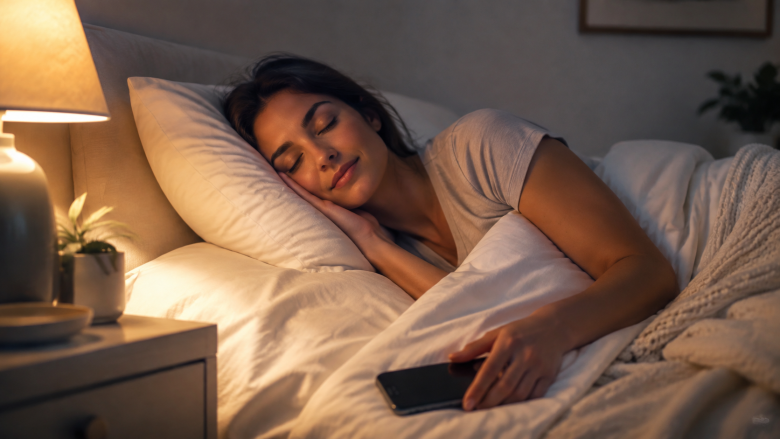
It's 2:47 AM. You're Scrolling Again. Here's Why Willpower Won't Fix It.
I remember the night I threw my phone across the bedroom. It was 2:47 AM, my eyes were burning, and I was on my third loop through Instagram. My jaw was tight, my heart was racing, and I was furious at myself. I told myself, "Tomorrow, I'll leave it in the living room." Tomorrow came, and I didn't. This went on for months. If you're reading this, you already know the drill: the guilt, the dry eyes, the exhaustion, and the 6:30 AM alarm that feels like a personal attack.
Here is the core truth you need to hear: You are not weak-willed. You are stuck in a sleep anxiety loop. The phone isn't the problem. It's the anesthesia. The real problem is the racing thoughts, the FOMO, and the cortisol spike that hits the second your head touches the pillow. Industry surveys suggest the average person checks their phone around 96 times a day, and a massive chunk of that happens in the sacred window between lights out and sleep. The fix isn't a digital detox. It's a psychological rewiring based on Cognitive Behavioral Therapy for Insomnia (CBT-I).
Why "Just Put It in Another Room" Fails (The Psychology Gap)
I tried the nuclear option everyone recommends. I bought a $20 alarm clock, moved my charger to the bathroom, and went to bed feeling smug. I lasted three nights. On the fourth night, I woke up at 1 AM with that familiar spike of dread in my chest. My mind was replaying a work email I'd sent that day. I tiptoed to the bathroom, grabbed the phone, and scrolled for 45 minutes. The shame was worse than the exhaustion.
Here's what most people don't realize: physical distance only works when the urge is a mild habit. When the urge is a coping mechanism for anxiety, you will always find a way to bridge the distance. Your brain has learned that checking your phone provides immediate relief from internal discomfort. It's a negative reinforcement loop. You feel anxious, you check, the anxiety dips for a few seconds, and then the anxiety returns, stronger, because you haven't actually solved anything.
Doomscrolling isn't boredom. It's emotional regulation. You're using the infinite scroll to distract yourself from the existential dread of being alone with your thoughts. The variable reward schedule of social media (sometimes you see a funny meme, sometimes a scary news alert) keeps your dopamine system hooked. This is why you can't "just stop". It's not a lack of discipline; it's a neurochemical loop that has hijacked your sleep architecture.
The Real Enemy Isn't Blue Light - It's Cortisol and Racing Thoughts
Everyone talks about blue light. And sure, blue light suppresses melatonin, the sleep hormone. But that's the minor player. The major player is the arousal state triggered by the content. When you read a stressful email, see a political post, or watch a thriller, your sympathetic nervous system fires. Your body releases cortisol. Your heart rate and blood pressure rise. You are now physiologically alert, even if you're lying down in a dark room.
This is why sleep onset latency (the time it takes to fall asleep) balloons to 30, 40, or even 60 minutes. You're trying to fall asleep in a state of fight-or-flight. The blue light filter on your phone (like Night Shift) doesn't solve this. It only makes the screen warmer. You're still reading about a financial crisis at 11:30 PM, and your brain doesn't care about the color of the light. It cares about the threat. The habit loop is Cue -> Craving -> Response -> Reward. The cue is the pillow. The craving is the desire to escape racing thoughts. The response is scrolling. The reward is a temporary dip in anxiety.
How Does My Phone "Know" You're in Bed?
You might have noticed your phone starts showing you "bedtime" reminders or switches to sleep mode at a specific hour. It doesn't have a camera pointing at you. It's using a combination of sensors. The accelerometer detects that you're not moving. The ambient light sensor detects darkness. But more importantly, it uses your historical usage patterns. If you consistently unlock your phone at 11:30 PM, the algorithm predicts you'll do it again. It's not psychic. It's just a very good pattern recognizer. This is exactly why it feels so personal when it sends you that "Screen Time" report on Sunday mornings.
The 3-Stage Sleep Psychology Protocol (CBT-I Integrated)
Instead of fighting the urge, we're going to reprogram the trigger. This is based on the core principles of Cognitive Behavioral Therapy for Insomnia (CBT-I), specifically stimulus control and cognitive restructuring. It's not a quick fix. It's a systematic rewiring that takes about two weeks to show significant results. I've used this with clients who were convinced they were "just night owls" and discovered they were actually anxiety avoiders.
Stage 1: Decouple the Bed from Alertness (Stimulus Control)
CBT-I has a strict rule: the bed is only for sleep and sex. If you're awake and frustrated, you get up. We're applying this to your phone. For the next two weeks, if you catch yourself reaching for your phone in bed, you must physically get out of bed. Go sit in a chair. Do a boring task like folding laundry or reading a manual. Don't look at your phone. The goal is to break the neural association between "bed" and "browsing". If you stay in bed and scroll, you're teaching your brain that the bed is a place for alertness.
This is the hardest stage. You will feel intense resistance. The first time I did this, I sat in a cold chair for 20 minutes feeling miserable. But that discomfort is the rewiring happening. What if you have an urgent call? You'll survive. The "urgent" call is almost always a text you can read in the morning. After a few nights, your brain will associate the bed with sleep again, and the urge to check will lose its power.
Stage 2: Schedule Your Worry (The Anxiety Loop Interrupt)
At the root of your nighttime checking is a fear of missing out or a fear of unresolved thoughts. Your brain uses your phone to avoid the 3 AM panic about that work email or that awkward conversation. We're going to schedule a "worry time". Set aside 15 minutes in the late afternoon, ideally around 4 or 5 PM. Write down every single worry on a piece of paper. Literally list them. "The Jackson report is due Friday." "I haven't called my mom." "My car is making a noise."
Use a physical notebook, not a note-taking app, because the app is on the phone you're trying to avoid. When you feel the urge to check your phone at night, tell yourself: "I have a scheduled time for this tomorrow at 4 PM. I don't need to think about it now." This is cognitive defusion - you're acknowledging the thought without acting on it. You're giving your brain a container for the worry, which paradoxically reduces the anxiety. The phone becomes less attractive because the underlying worry has a home.
Stage 3: The Morning Rewiring (Breaking the Night-Morning Connection)
The loop isn't just at night. It's a 24-hour cycle. According to the American Academy of Sleep Medicine, nearly 90% of adults use a screen in the hour before bed. But the morning is the anchor. When you wake up and immediately grab your phone, you train your brain that the phone is the first thing that matters. This primes your dopamine system for the day, making the night urge stronger.
To answer the other question you're probably asking: what percent of people check their phone first thing in the morning? Various industry surveys suggest that over 60% of young adults check their phone within 5 minutes of waking up, and a large majority keep it within arm's reach all night. The fix here is to enforce a "no-phone for the first 30 minutes" rule. Instead of checking your phone, drink a glass of water, look out the window for 2 minutes to reset your circadian rhythm via natural light, and just sit with the silence. It feels profoundly uncomfortable for the first few days, but it resets your baseline.
Practical Tactics That Actually Work (When to Use What)
Let's talk about the tools. App blockers like Opal and Forest are excellent for the habitual scroller who lacks awareness. They create a friction barrier. But they fail for the anxious scroller because you'll just uninstall them in a moment of panic. I know this because I've done it.
Here's a decision matrix. If you have ADHD and struggle with impulse control, use an app blocker with a strict "hard block" that you cannot bypass (like Opal's strict mode). If your issue is racing thoughts, skip the app blocker and use the "worry time" technique first. If your issue is FOMO, turn off all non-human notifications (only allow texts and calls from actual people).
The 20-Minute Wind-Down Window
Set a physical alarm for 20 minutes before you intend to sleep. When it goes off, your phone goes into "airplane mode" and goes face down on the nightstand (or in the bathroom). You then do a low-stimulation activity: reading a physical book, light stretching, or taking a shower. This isn't about relaxing perfectly. It's about signaling to your body that the input has stopped. A sleep psychologist would call this "sleep hygiene", but the key here is the physical alarm. Your phone's alarm won't work because you'll just snooze it and check your notifications.
The "Urge Surfing" Technique (Applied to Doomscrolling)
Urge surfing is a mindfulness technique from addiction therapy. When the urge to grab your phone hits, don't fight it and don't give in. Notice it. Label it. "I am feeling the urge to check my phone." Breathe in for 4 seconds, hold for 4, exhale for 6. The urge usually peaks within 90 seconds. If you can ride that wave without acting, the craving diminishes. It feels terrible for a minute, but it teaches your brain that the urge is just a wave, not a command. It's a sensation in your body, not a truth you have to obey.
The "Dumb Charger" Middle Ground
If leaving the phone in another room feels too extreme, try the middle ground. Buy a cheap alarm clock. Charge your phone in the living room. But keep a pad of paper and a pen on your nightstand. When a random thought pops up that you feel you must address, write it down. The physical act of writing it down is enough to convince your brain you won't forget it. This bridges the gap between the anxiety-driven urge and the practical need to remember something.
Edge Cases: Shift Workers and New Parents
If you're a shift worker, the 20-minute wind-down is even more critical because your circadian rhythm is already disrupted. Use blackout curtains and a white noise machine. Your phone is not your enemy; the lack of a consistent sleep signal is. If you're a new parent, your situation is unique. You are legitimately waking up to care for a baby. The goal isn't to ignore your child. The goal is to avoid the 45-minute doomscroll after you've put the baby back down. Use the urge surfing technique specifically for that post-feed window.
What to Do When You Slip (And You Will)
I slipped last week. I woke up at 3 AM, my mind racing about a deadline, and I grabbed my phone. I scrolled for 25 minutes before I caught myself. The shame hit immediately. But here's the thing: the shame is just another anxiety spike that makes you want to scroll more. It's a secondary loop that keeps you trapped.
The recovery protocol is simple. Put the phone down. Don't count the minutes you lost. Don't punish yourself. Just close your eyes and restart the breathing. Focus on the physical sensation of the sheets, the sound of the room. Research on habit formation suggests it takes an average of 66 days for a new behavior to become automatic. You will have bad days. The key is to not let one slip turn into a full-blown relapse. If you go from 5 nights a week to 2 nights a week, that's a 60% improvement. Don't throw away the progress because of one bad night.
The Metabolic Connection: Why Sleep Fixes More Than Your Mood
Beyond your mental state, this nighttime scrolling is wrecking your metabolism. Poor sleep elevates ghrelin, the hunger hormone, and suppresses leptin, the fullness hormone. You're also decreasing your resting metabolic rate. The link between sleep and weight is so strong that the CDC lists insufficient sleep as a public health epidemic.
If you're curious about how much energy your body burns while you sleep, you can use our bed fat burned calculator to get a rough estimate based on your weight, age, and sleep duration. But remember, the calculator just shows the baseline. Fixing your sleep onset latency and reducing your nighttime cortisol is what actually moves the needle on your metabolic health.
The Bottom Line: Stop Fighting the Phone, Start Healing the Anxiety
The next time you're lying in bed and your hand reaches for the glowing screen, pause. Ask yourself: "What am I avoiding right now?" The answer is usually a feeling of boredom, fear, or uncertainty. The phone is just the anesthesiologist. To stop checking your phone in bed, you have to stop numbing that feeling.
Here's your 3-step action plan for tonight: 1. Set a physical alarm for 20 minutes before bed. 2. Write down your worries on paper. 3. Put the phone in another room. Just for tonight. Start with the 3-stage protocol. Schedule your worry. Decouple your bed. Rewire your morning. It won't be perfect. Some nights you'll fail. But you're not trying to be a robot. You're trying to reclaim your sleep from an anxiety loop that doesn't serve you. The goal isn't to be phone-free. It's to be present enough in your own bed to actually rest.