The most honest answer to "how to build a routine for gym days" is this: you do not need a perfect workout plan. You need a system that gets you through the door on the days you do not want to go. The exercise selection matters, but the behavioral loop matters more. After a decade of coaching and a lifetime of training, I can tell you that the difference between people who see results and those who quit is rarely knowledge. It is the ability to show up when motivation dies, which it will, usually around week three. This guide is about building a routine that survives work stress, bad sleep, and the existential dread of a crowded Monday night gym.
Why Most Gym Routines Fail Before the First Sweat
When I first started training seriously, I made the classic mistake. I designed a six-day program with a spreadsheet, color-coded intensity zones, and a diet plan that required a personal chef. It lasted eleven days. The problem was not the exercises. The problem was that I had built a routine for an idealized version of myself who had unlimited energy and no social life. That version does not exist.
Most people fail because they conflate a workout plan with a routine. A workout plan tells you what to do. A routine tells you how to make yourself do it, even when you are tired, busy, or anxious. The research supports this. According to the Harvard Medical School, linking exercise to a specific cue and rewarding yourself afterward are key components of making the habit stick. You are not building muscle; you are building a behavior.
The thing nobody tells you about gym routines is that the first month is mostly about logistics, not physiology. You are figuring out when your gym is empty, which locker works, and how to survive the squat rack anxiety. Until you solve those practical problems, no amount of "optimal training frequency" matters.
The Habit Loop: Cue, Routine, Reward
To build a gym routine that becomes automatic, you need to engineer a habit loop. This is not a productivity gimmick. It is the neurological process by which behaviors become automatic. You can use it to make the gym feel as normal as brushing your teeth. The loop has three parts, and you need to design all three deliberately.
The Cue: Make the Decision for Future You
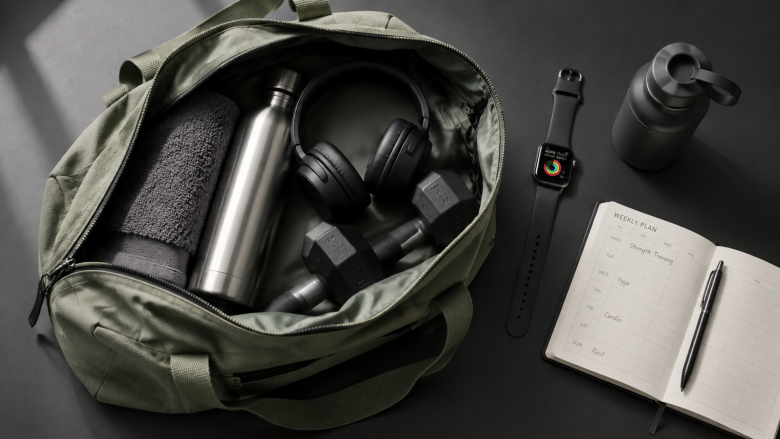
The cue is the trigger that starts your gym behavior. The best cues are environmental, not mental, because they do not require willpower to activate. The most powerful cue I have found is packing your gym bag the night before. This is not a cliche. It is a decision made in advance that removes friction from your future self. When you pack the bag, you are telling tomorrow's you: "The gym is happening."
Place the bag somewhere you cannot miss it. By the door, on the passenger seat of your car, or in the middle of the kitchen floor. If it is out of sight, it is out of mind. You are not relying on memory. You are relying on a physical object that triggers the thought: "Ah, right, I have to go."
Another effective cue is a time-based anchor. Attach your gym session to an existing habit. For example, "After I drop the kids at school, I drive to the gym" or "The moment I clock out, I change into my shorts." The key is to make the cue specific and unavoidable. "I will work out sometime this week" is not a cue. It is a wish.
The Routine: Start Smaller Than You Think You Need
The routine is the actual workout, but here is the secret: the routine should be embarrassingly easy to start. When I coach beginners, I do not prescribe a 60-minute full-body split. I prescribe a 20-minute minimum. That is it. If you can only do twenty minutes, you do twenty minutes and you leave with a win. The goal is not to maximize muscle damage on day one. The goal is to create a memory of success.
This is where most people fail. They think a "real" gym session must be an hour of grinding. They miss a day, feel guilty, and then overcompensate by doing a two-hour marathon that leaves them sore for a week. That soreness becomes another excuse to skip. It is a vicious cycle of boom and bust. A 20-minute baseline breaks that cycle because it is sustainable.
Once you have consistently shown up for 20 minutes for a few weeks, you can extend the time. You will naturally want to, because you will start seeing progress. But you have to earn the right to add volume by first mastering the habit of showing up. The workout itself can be simple. A few compound lifts, some machines, some cardio. The specific exercises matter less than the fact that you are moving your body on a schedule.
The Reward: Log It and Feel the Win
The reward is the payoff that tells your brain this behavior is worth repeating. The most effective reward is a sense of accomplishment. You can manufacture this by logging your workout immediately after you finish. Write down what you did, how it felt, and how long it took. This does not need to be a detailed training journal. A note on your phone is enough.
The act of logging creates a feedback loop. You see a list of completed sessions, which is visual proof that you are showing up. That proof is powerful. On the days you feel like you are not making progress, you can scroll back and see that you have trained six times this month. That is a fact. You cannot argue with a fact. This is why I recommend tracking your workout in a notes app or a dedicated app like Strong or Hevy.
Another critical reward is the post-workout feeling. For the first few weeks, pay attention to how you feel after you leave the gym. You might feel energized, calm, or proud. That feeling is your brain's reward chemical. Savor it. Do not immediately rush to check your phone or think about work. Let the feeling sink in. This is how you teach your brain that the gym is a source of positive feelings, not just a chore.
The "If-Then" Plan for When Life Goes Wrong
No routine survives contact with reality without a contingency plan. You will have days when you are exhausted, when work runs late, or when your kid is sick. The people who maintain their routines are not more disciplined. They have a plan for the obstacle. This is called an implementation intention, and it is one of the most effective behavioral strategies I know.
The format is simple: "If [obstacle], then [small action]." You write these in advance, when you are thinking clearly, so you do not have to make a decision in the moment when you are tired. Decision fatigue is real. If you have to decide whether to go to the gym at 7 PM after a brutal day, the answer will usually be no. But if you have a pre-written plan, you do not have to decide. You just execute.
Here are some if-then plans that work in real life:
- If I am exhausted after work, then I will do a 10-minute warm-up and reassess. Most of the time, the warm-up will change your energy level. If it does not, you have permission to stop. But you showed up. That is the habit.
- If I miss my morning session, then I will go during lunch or after work. You are not allowed to miss the day entirely. You just move the appointment.
- If I only have 20 minutes, then I will do a superset circuit of my main lifts. You can get a surprising amount of work done in 20 minutes if you superset and minimize rest.
- If I feel too anxious to go inside, then I will just walk into the gym and do one set of something. The goal is to break the mental barrier. Once you are there, the anxiety usually fades.
When I first started, I had a rule for myself: "If I do not want to go, I will go and just walk on the treadmill for 15 minutes." By the time the 15 minutes was up, I had usually warmed up enough to do my workout. The hardest part is always the decision to walk through the door. The if-then plan removes that decision.
Building the Actual Workout Plan (The Simple Version)
Now, let us talk about the workout itself. You do not need a complex program to see results, especially in the first six months. You need a plan that is simple, progressive, and that you can actually execute. The best plan is the one you will do consistently. Here is a framework that has worked for hundreds of people I have coached.
Start with a full-body routine three days a week. This is the most efficient approach for beginners and for people with limited time. You hit every major muscle group with one compound lift, then add a few accessory movements. This gives you three rest days in between, which is plenty for recovery.
A Sample Three-Day Full-Body Split
This is a template. You can swap exercises for machines or dumbbells if you are not comfortable with barbells. The key is to pick a weight that is challenging but allows you to complete all your reps with good form.
- Workout A: Squat (3 sets of 5 reps), Overhead Press (3 sets of 8), Row (3 sets of 10), Plank (3 sets of 30-60 seconds).
- Workout B: Deadlift (3 sets of 5), Bench Press (3 sets of 8), Pull-ups or Lat Pulldown (3 sets of 8), Hanging Knee Raises (3 sets of 10).
- Workout C: Leg Press (3 sets of 10), Incline Dumbbell Press (3 sets of 10), Seated Cable Row (3 sets of 10), Face Pull (3 sets of 15).
Alternate between A, B, and C. So your week might look like Monday A, Wednesday B, Friday C. The next week, you start with B. This gives you variety without overcomplicating things. Add weight or reps each week. This is called progressive overload, and it is the single most important principle for building muscle and strength.
If you have more time and want to train four or five days a week, you can split the body into parts. An upper/lower split is a great next step. But for the first three to six months, the full-body routine is superior because it builds a habit of frequency without burning you out.
Overcoming Gym Anxiety: The Silent Routine Killer
I have seen it a hundred times. A person has a perfect plan, they are motivated, and then they walk into the gym and feel overwhelmed. Everyone seems to know what they are doing. The weights are loud. The mirrors are unforgiving. They do one exercise, feel judged, and leave. Gym anxiety is real, and it is the reason many routines die before they start.
The first thing to know is that no one is looking at you as much as you think. People in the gym are mostly focused on themselves, their music, and their form. The buff guy doing curls in the mirror is not critiquing your squat. He is checking his own bicep peak. This is a simple truth, but it does not make the anxiety disappear. You need a strategy to work through it.
When I first started, I was terrified of the free weights section. The solution was to go at off-peak hours. I trained at 6 AM, when the gym was quiet and I had room to figure things out. If you have flexibility, try going at a time when the gym is less crowded. Lunchtime or late evening can also work. The empty gym is your friend. It allows you to practice without an audience.
Another strategy is to have a plan and write it down. When you walk in, you know exactly what you are doing. You do not wander around looking lost. You go to your first exercise, do your sets, and move on. This confidence comes from having a written plan. It is one of the reasons I recommend a simple program over a complex one. A simple program is easier to memorize and execute.
Finally, start with machines if you are nervous. Machines are self-explanatory, and they prevent you from worrying about form. Once you build confidence on machines, you can graduate to free weights. There is no shame in this progression. It is a path many of us have taken. The goal is to get comfortable, not to prove anything to anyone.
Rest Days Are Part of the Routine, Not the Enemy
Most people think of rest days as the absence of a routine. They are not. Rest days are the days when your body repairs the muscle you broke down. They are as important as the training days. Skipping rest days is a fast track to injury, burnout, and eventually quitting. You do not build muscle in the gym. You build muscle when you sleep and rest.
Your rest days should have a structure too. They are not days to be completely sedentary. Active recovery is the goal. A 20-minute walk, some gentle stretching, or a yoga session can do wonders for your sore muscles and your mental state. This counts as part of your overall routine. It keeps you connected to your fitness goals without the stress of a workout.
One thing I learned the hard way is that rest days are when you feel the most sore. This is called delayed onset muscle soreness, and it peaks about 48 hours after a workout. Do not let this shock you. If you are incredibly sore, that is a sign you did a lot of work, but it is also a sign you might have overdone it. In that case, your rest day should include extra sleep, hydration, and possibly a hot bath.
For a deeper look at how to structure your evenings to ensure you get quality sleep, which is the most important recovery tool you have, see our guide on creating a calming evening wind-down routine. Good sleep is the secret weapon of any successful gym routine.
Handling Missed Days Without Falling Off the Wagon
Here is the hard truth: you will miss days. You will get sick. You will go on vacation. You will have a work deadline that destroys your schedule. This is not a failure. It is life. The difference between people who maintain a routine and people who quit is how they handle the missed day.
The biggest mistake is the "all or nothing" mindset. You miss one workout, and you tell yourself, "Well, I ruined my streak, so I might as well quit." This is perfectionism, and it is the enemy of consistency. You need to adopt a "never miss twice" rule. If you miss a day, that is fine. But you do not miss the next scheduled day. This keeps the miss from becoming a slide.
When you come back after a break, do not try to make up for lost time with a monster workout. That is a recipe for injury and extreme soreness. Just go back to your regular plan. Your body will quickly regain what it lost. It is like riding a bike. You do not need to relearn how to squat. You just need to do it again.
I remember a period when I was traveling for work for three weeks. I did zero workouts. When I came back, I was dreading the gym. I felt like I was starting from zero. I forced myself to go and do my easiest workout, the 20-minute minimum. It was tough, but I did it. The next week, I was back to my normal weights. The break did not erase my progress. It just paused it.
Motivation Is a Trap: Rely on Systems Instead
Everyone asks me how to stay motivated. My answer is always the same: do not rely on motivation. Motivation is a fleeting emotion. It is great when it is there, but it will not be there on a rainy Tuesday morning. You need systems that function without motivation. This is the core of building a routine that lasts.
A system is a set of rules and cues that make the behavior automatic. We talked about the habit loop and if-then plans. Those are systems. Another system is a schedule. You decide in advance which days you train and at what time. You treat it like a meeting with yourself. You do not cancel meetings with yourself unless there is an emergency.
Another system is accountability. Tell a friend you will meet them at the gym. Join a class where the instructor notices if you are absent. Hire a coach. When you have external accountability, you are less likely to skip. This is not weakness. It is using the social nature of humans to your advantage.
Finally, make your goal about the behavior, not the outcome. Do not set a goal to "lose 20 pounds." Set a goal to "train three times a week for the next month." The outcome goal is out of your control in the short term. The behavior goal is fully in your control. When you hit the behavior goal, you get a win, which fuels more behavior. The weight loss will follow.
Recovery and Nutrition: The Other 23 Hours
Your gym routine is only one hour of your day. What you do in the other 23 hours matters just as much, if not more. Recovery and nutrition are where the results are built. A great workout followed by a terrible diet and no sleep is like trying to fill a bucket with a hole in it.
Sleep is the most underrated performance enhancer. You need seven to nine hours of quality sleep per night for optimal recovery. During deep sleep, your body releases growth hormone, which repairs muscle tissue. If you are not sleeping, you are not growing. Your performance in the gym will also suffer. A tired person cannot lift as heavy or run as fast.
For protein, you need a decent amount to repair muscle. A general guideline is about 0.7 to 1 gram of protein per pound of body weight, but this can vary. For a standard 180-pound person, that is around 126-180 grams of protein per day. This can be from meat, eggs, dairy, beans, tofu, or protein powder. Spread it across your meals.
You also need carbohydrates for energy and fat for hormone function. Do not cut carbs entirely, especially on training days. You need the fuel. A simple approach is to eat a meal with carbs and protein a few hours before your workout, and another one within a couple of hours after you finish.
Hydration is also critical. Even mild dehydration can impair performance. Aim to drink water throughout the day, not just during your workout. A good rule is to drink a glass of water when you wake up and with every meal.
How to Make Your Routine Stick Long-Term
At this point, you have a plan. You have a habit loop. You have if-then plans for obstacles. You know about rest and recovery. The final piece is the long-term mindset. How do you keep this going for years, not just for a few weeks?
The first thing is to be flexible. Your routine will need to change as your life changes. When I had my first child, my 6 AM gym sessions became impossible. I had to shift to lunchtime workouts at an office gym. The routine changed, but the habit remained. If you cling to a rigid schedule, you will break. If you adapt, you will survive.
Second, find joy in the process. If you hate every workout, you will eventually quit. Experiment until you find a style you enjoy. Maybe you hate running but love lifting. Maybe you hate lifting but love group classes. The best workout is the one you do not dread. Your routine should be something you look forward to, not something you have to force yourself through.
Third, track your progress beyond the scale. The scale can be deceptive. It goes up and down with water weight, food intake, and other factors. Instead, track your strength, your endurance, or how your clothes fit. Notice that you can run a mile without stopping. Notice that the stairs at work are easier. These are the wins that keep you going.
Finally, be compassionate with yourself. There will be bad weeks. There will be times when you eat poorly and skip workouts. This is normal. Do not beat yourself up. As we discussed in our article on building self-compassion in everyday life, treating yourself with kindness is a more effective motivator than harsh criticism. You are building a lifelong habit, not a perfect two-week sprint. Forgive the misstep, and get back on the plan at the next scheduled session.
Putting It All Together: Your First Week
Here is what your first week with this framework might look like. This is a template, not a prison. Adjust it to your life.
Sunday Evening: Plan your week. Write down which days you will train. Pack your gym bag and place it by the door. This is your cue.
Monday: Follow your cue. Go to the gym. Do your 20-minute minimum. Log it. Feel the win.
Tuesday: Rest day. Go for a 20-minute walk. Eat well. Go to bed early. Your evening routine matters here. If you struggle to wind down, check out our guide on an evening routine for restful nights.
Wednesday: Gym day. Repeat the loop. Maybe you have a bit more energy today. Add a few extra minutes.
Thursday: Rest day. Active recovery. Stretch. Hydrate.
Friday: Gym day. Finish the week strong. Log the session.
Saturday: Rest. Do something fun. You have earned it.
This is the blueprint. It is not about being perfect. It is about being consistent. The gym is a place you go, not a place you think about going. That is the whole secret. Build the cue, keep the routine simple, and reward yourself for showing up. The rest will follow.
Most people overestimate what they can do in a month and underestimate what they can do in a year. A simple routine, repeated consistently, will transform your body and your mind. It has for me, and it can for you. Start with one day. Then make it two. Then make it a habit.